Steven Halpern is a Grammy nominated musician and has been
composing mindful meditation music for more than years 45 years. He is also a
producer, researcher, author, and sound healer. Halpern uses mindfulness when
composing his music. He allows the notes to flow freely and provides a musical background
that keeps you in the present instead of anticipating where the song will go
next.
Halpern’s music encourages alpha and theta waves, which are brainwaves that are active in deep relaxation. This was something that I knew nothing about before and found extremely interesting. I also learned that we are conditioned to anticipate patterns in music, which is defined by the term “anticipation response.” Being influenced by mindfulness, Halpern’s music promotes being in the “hear and now.” Through his music, my understandings of the benefits of mindfulness expanded.
Sibel Ozer, an artist that runs a process painting group in
Southeastern Michigan, used mindfulness to guide her class. She engaged in process
of keeping focused on the present moment with her group. Just as you would refocus
your mind to your breath when engaging in a breathing technique, Ozer
encouraged the group to refocus their thoughts to the canvas in front of them,
letting each moment guide their artwork. She began with a colorful piece of
work in the first week allowing herself to do what felt right instead of planning
what she thought others would like. In the second week, she covered her canvas
in black, but allowed her inner critic to judge her work. She voiced this to
her group and allowed the process to begin again. In her blog on The Crazy Wisdom
Community Journal, Ozer states, “It occurred to me that everything is birthed out
of the dark; that it is out of the void that things begin to emerge. With that
rephrase I was able to stay with the black as long as I needed.” She
added a snake, which she mentions is a symbol of transformation and eventually
the face of Kuan Yin, who in Buddhist beliefs, is the goddess of mercy and
compassion. She shares that the process of painting is in its nature a very
mindful activity. The artist must be focused on the work in front of them and
rid themselves of past and future influences. Being mindful means being in the
present moment nonjudgmentally. To fully free themselves, an artist will need
to create art without judgement, which is also plays a major role when
practicing mindfulness.
I never thought that people could connect mindfulness to different activities such as art. After seeing the process that Sibel Ozer took during her artwork, I now see how the ideas behind mindfulness work hand in hand with art. Ozer also mentions that our mind sometimes allows critical thoughts to come through. These are thoughts of the past influences and future worries which is not being in the present. This was an interesting notion to me as I now see how our self-criticism can be harmful to the mindfulness process. Through Ozer’s art, I deepened my understanding of what mindfulness is and what it can be used for.
The trees before you and the bushes beside you are not lost. Wherever you are is a place called Here, And you must treat it as a powerful stranger, Must ask permission to know it and be known. The forest breathes. Listen. It answers, I have made this place around you, If you leave it you may come back again saying Here.
No two trees are the same to Raven. No two branches the same to Wren. If what a tree or a bush does is lost on you, You are surely lost. Stand still. The forest knows Where you are. You must let it find you.
I found this poem by David Wagoner to be strongly connected
to the concept of mindfulness. The idea of being present in the moment is an
essential part to the mindfulness method. By mentioning the word “here” in his
poem, Wagoner is implying the importance of being aware of the current moment. He
states, “If you leave it you may come back again saying Here.” He is conscious
to the fact that the mind may wander while practicing mindfulness meditation,
but refocusing your attention to the present is possible. In this poem there is
also a powerful relationship between the individual and nature. Mindfulness is
not only being aware of yourself but also being in tune with the environment
around you.
David Wagoner uses personification in his poem to describe mindfulness. The notion of asking permission to know the concept of being “here” was new to me. Mindfulness is all about trying to be present in the moment, but I did not think of treating the moment as a person and asking for consent before practicing. The poet also implies that we should let mindfulness find us instead of chasing and forcing the use of it. This was a helpful resource in strengthen my idea of what mindfulness is.
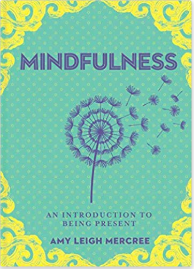
Amy Leigh Mercree introduces
mindfulness in very clear and simple sections. She defines what mindfulness is,
goes over its history, looks into into the science behind it, distinguishes
different types of mindfulness, and provides the reader with guided
meditations. Like many other definitions, Mercree defines mindfulness as being
present in the moment and becoming more self-aware. She adds that mindfulness
also involves the practice of not over reacting to your environment. Mercree
states that “today’s hot yoga groups, Mindfulness-Based Stress Reduction (MBSR)
classes, and online meditation videos are offshoots of rituals steeped in
history” (Mercree, pg. 7). Hinduism, Buddhism, and yoga have rich histories
that have influenced what we know as mindfulness today. Vedic traditions
stemming from 1500-600 BCE were grouped together and referred to as Hinduism by
writers in Great Britain in the 1800s. Vedic traditions such as yoga and meditation
are widely used today. Buddhism’s first step in the path to enlighten involves
being mindful and to be aware that “any idea or feeling that mindfulness practitioners
have is just one though in a sea of other thoughts” (Mercree, pg.8). In the
past, yoga was a spiritual practice that involved self-reflection and mindfulness
to reach higher levels of enlightenment, but it has evolved into a physical
exercise with roots in training the mind. Mecree also credits Dr. Jon Kabat-Zinn
with introducing mindfulness to the U.S with his Mindfulness-Based-Stress Reduction
(MBSR) classes. People like Dr. Jon Kabat-Zinn at the University of
Massachusetts Center for Mindfulness, Dr. Amishi Jha at the University of Miami,
Dr. Michael Mrazek at the University of California Santa Barbra, and Dr. Dan
Siegel the University of California Los Angeles all study the effects of
mindfulness on attention, memory, emotions, and behavior. Mindfulness has shown
to reduce stress, manage emotions, improve relationships, enhance working memory,
and boost the immune system. In 2016, after analyzing twenty different studies,
researchers found that “mindfulness mediation correlates with reduced inflammation,
increased immune cell antiaging, and increased antibodies” (Mercree, pg. 23). With studies showing the benefits of
mindfulness, schools, businesses, and even the government have adopted
mindfulness training programs.
Mercree notes in her chapter on the history of mindfulness, that the word sati is the foundation of mindfulness. Sati, which is the main focus of Buddhism, translates to mindfulness. Though she mentions that when directly translating from Sanskrit, it means to bear in mind. I had not heard of this word or its meaning before and loved that she focused in on this single word. In the section on the different types of mindfulness practice, Mercree presents the Tibetan Buddhist meditation practice of Tonglen. I had never heard of this practice and was pleasantly surprised to find out that it is a technique that can help expand love and kindness within a person. Tonglen is the practice of using breathing exercises to purify an individual’s karma. You start by breathing in your suffering and the suffering of others’ and then breathing out your intentions for those who are suffering. For example, if you are thinking of people without food, you “breath out” food. This was a great book was a great reference for all three of my guiding questions. It touched on the concept of mindfulness, went into its history, and referred to studies that proved how beneficial mindfulness can be.
Mercree, A. L.
(2018). A little bit of mindfulness:
An introduction to being present. New York, NY: Sterling Ethos.
Zen gardens have been a popular tool to use for those who
practice mindfulness mediation. People can invest in small individual zen
gardens for their homes, place of work, or anywhere they would like to meditate. These gardens are made up of
sand, rocks, and a small rake. According to Banu Ibrahim on cnn.com, “it’s
believed that raking the sand of these desk zen gardens and creating swirling
patterns help calm your mind.” In his article he provides links to affordable
kits on amazon.
Although I have seen zen gardens before, I never knew why they were made up of rocks, sand, and a rake. In an article by Gunjan Verma on indiatimes.com, Verma explains that sand in a zen garden symbolize our lives, while the rocks symbolize life’s obstacles. Through this article I learned that Zen is tied to the Japanese tradition of Mahayana Buddhism which focuses on meditation and intuition over worship and scriptures. Through my research on zen gardens I understood more of the roots of where mindfulness came from, and different ways to reach the benefits of this practice.
A “singing bowl” is widely used in the practice of mindfulness. Using the mallet, the user presses it against the outer rim and moves it in a circular motion. This motion creates a clear tone that fills a room. This tone is thought to reduce stress, promote relaxation, and increase mental clarity. According to liveboldandbloom.com, singing bowls “create a range of sounds that are believed to restore the normal vibratory frequencies of any part of the body, mind, and soul that is out-of-harmony or even diseased.” This website offers a brief history, the benefits of using singing bowls, a guide to how to find and use the tool and recommends seven bowls for mindfulness practice.
It was interesting the learn the history behind singing bowls. They came from India to Tibet in the 8th century through the tantric master Padmasambhava and using sound vibrations to heal the body is an ancient practice from thousands of years ago. I also was unaware of the different ways to use produce a tone from a singing bowl. You can start by tapping the side of the bowl or circulating the rim. This artifact helped me understand more of this history of mindfulness and what benefits can be gained for those who practice mindfulness.
Like many of the other articles discussed, Neves-Pereira, Bilibio de Carvalho, & de Campos Aspesi (2018) begin with a brief history of mindfulness. Stemming from Buddhist traditions, mindfulness, according to the authors, began making its way to the West around the Victorian Era through Buddhism. They go on to say that although western culture relies more on science than religion as a bases of knowledge, researchers have found ways to study spiritual traditions. From there we have been able to implement this research into the fields of Psychology and Education. “From an educational perspective, mindfulness can be viewed as a reeducation of the habitual internal posture, in which one exercises actions in connection with the sensorial and perceptive functions that lead to expanded states of consciousness” (Neves-Pereira, Bilibio de Carvalho, & de Campos Aspesi, pg. 147). With its focus on full attention and being present in the moment, mindfulness has gained popularity in the realm of human development. “Studies on how contemplative practices improve attention, emotional response, and social adjustment among children and adolescents have just been initiated.” (Neves-Pereira, Bilibio de Carvalho, & de Campos Aspesi, pg. 148).
The authors referred to Buddhism as religious and philosophical model with scientific rationales. While reading this article I realized that I did not know that Buddhism supported many science-based theories. This article illustrated how although we as a Western culture rely more heavily on science than spirituality, there has been many studies done on the topic of mindfulness to inform therapists and educators on it benefits. Although I knew that the fields of Psychology and Education take careful consideration of what practices they use, it did not occur to me that the use of mindfulness was only truly adopted into the fields after to the accumulation of research of the physiological effects. Knowing that there is research on the effects of mindfulness that show positive outcomes, informs me on how its use can benefit students in the classroom.
In their article, Greenwalt and Nguyen (2017) recognize that mindfulness has roots in many cultures but chose to focus their thoughts on the Buddhist traditions and how those traditions came to America. The authors defined mindfulness as “the practice of observing one’s own body, feelings, mind, and objects of the mind in the present moment, nonjudgmentally, and in relation to the living environment” (Greenwalt and Nguyen, 2017, pg. 54). The authors mention that World War II had an impact on transferring different beliefs, like Buddhism, to America, along with the Southeast Asian immigrants coming to America to escape warfare. This article touches on the interactions we have with our environment through mindfulness and relate this to John Dewey’s theory of mind. They note that Dewey would have accepted the idea of a person being present in the moment with their environment and to be aware of themselves and others. They end the article by recommending that teachers be conscious that though they are using mindfulness in the classroom to reduce stress and anxiety, the source of that stress and anxiety may be stemming from the structure of the school day.
I especially enjoyed that this article looked at the word “nonjudgmentally” in more depth. Through my research on this topic, I have come across this word many times, but did not know the constraints of this term. Turns out, the word “constraints” is an ill-advised view of the overall concept. “Nonjudgmentally” implies that when practicing mindfulness, the aim is not to control your thoughts, but to notice them just as they are. Greenwalt and Nguyen (2017) also touch on the familiar name of John Dewey. As a student of education, I have heard his name many times, and knew of his beliefs in a hands-on approach to learning, but never thought to connect his theories to mindfulness. This article clarified what mindfulness is, dove deep into its origins, and linked it to educational theories.
Greenwalt, K. A., & Nguyen, C. H. . (2017). The mindfulness practice,
aesthetic experience, and creative democracy. Education & Culture, 33(2),
49–65. doi:
0.5703/educationculture.33.2.0049
In her article, Kalpana Gupta takes the reader through the sacred and historical roots of mindfulness and how globalization has taken its ideas to the Western world. Cultures from the East have been practicing mindfulness for centuries through Hinduism, Buddhism, and Taoism. It began as a spiritual practice that was intended to guide an individual’s way of life. According to Gupta, mindfulness and meditation are “philosophically, spiritually, culturally, and religiously embedded” (Gupta, 2019). The author defines meditation as the “state of ultimate consciousness” and reminds readers that it originated as and still has a spiritual purpose in Eastern cultures. With globalization, popularity of mindfulness has spread as a technique to reduce stress and anxiety. “More recently, Western culture, specifically the United States, has been infatuated with mindfulness and meditation as a means to reduce stress, anxiety, and improve focus and attention” (Gupta, 2019). She encourages those who use mindfulness to familiarize themselves with the history of this practice if they are to imbed it into academics.
Many insightful comments on this topic jumped out at me while reading this article. I knew that mindfulness, yoga, and mediation had a long history but did not know exactly where they started, how they started, or who started them. Gupta mentions that according to Murphy et al. (1997), scriptures from pre-Aryan civilizations are the first to mention meditation. I was also surprised to learn that different branches of Buddhism are meant to lead an individual to different forms of enlightenment. Some branches focus on a still and relaxed mind while others aim to target alertness. Through this article, I was able to gain more insight to the history behind mindfulness.
Gupta, K. (2019). The sacred to the
secular: Using mindfulness and meditation as instructional methods in academia.
New Directions for Adult and Continuing Education, (161), 21–32. doi: 10.1002/ace.20308
This article addresses the effectiveness of mindfulness on
students and teachers when a whole-school approach is used. Michele L. Kielty,
Tammy D. Gilligan and A. Renee Staton state that the school personnel,
students, families, and local communities experience positive outcomes when they
are all involved in implementing mindfulness across the school community. The
authors state that mindfulness plays a positive role in physical and mental
health. Students who have learned mindfulness techniques can extend their practice
beyond the classroom. “Many
students were able to comment on the potential for using mindfulness-based
practices in the future to deal with life, work, and family stressors.” (Whole-School
Approaches to Incorporating Mindfulness-Based Interventions: Supporting the
Capacity for Optimal Functioning in School Settings, pp 132).
When
reading this article, it had occurred to me that I had only thought of
mindfulness at the personal and classroom level, but never thought of implementing
it as a practice throughout a whole school or district. I was pleasantly
surprised to know that there are training programs like “Mindful Schools” that the
public can attend to strengthen their practice in mindfulness. This resource
helped me understand just how beneficial mindfulness can be to students when educators
work together and are trained appropriately.
Kielty, M. L., Gilligan, T. D., & Staton, A. R. (2017). Whole-school approaches to incorporating mindfulness-based interventions: Supporting the capacity for optimal functioning in school settings. Childhood Education, 93(2), 128–135. doi: 10.1080/00094056.2017.1300491





 My Content Resources