Creative Work

Mindful Piano by Steven Halpern

Halpern, S. Mindful Piano. (2015, September 26). Retrieved July 7, 2019, from https://www.stevenhalpernmusic.com/product/mindfulpiano/

Steven Halpern is a Grammy nominated musician and has been composing mindful meditation music for more than years 45 years. He is also a producer, researcher, author, and sound healer. Halpern uses mindfulness when composing his music. He allows the notes to flow freely and provides a musical background that keeps you in the present instead of anticipating where the song will go next.

Halpern’s music encourages alpha and theta waves, which are brainwaves that are active in deep relaxation. This was something that I knew nothing about before and found extremely interesting. I also learned that we are conditioned to anticipate patterns in music, which is defined by the term “anticipation response.” Being influenced by mindfulness, Halpern’s music promotes being in the “hear and now.” Through his music, my understandings of the benefits of mindfulness expanded.

Halpern, S. (n.d.). 02 Mindful Piano sample. Retrieved July 7, 2019, from https://www.stevenhalpernmusic.com/product/mindfulpiano/

To learn more about Steven Halpern:
Click to access IPM8092_Mindful.Piano.web-linernotes.pdf

Creative Work

Process Painting and Mindfulness by Sibel Ozer

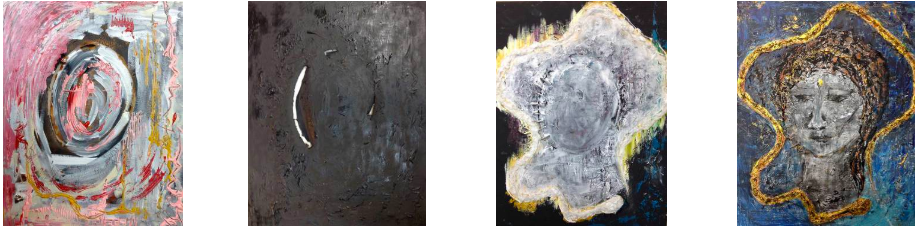
Sibel Ozer, an artist that runs a process painting group in Southeastern Michigan, used mindfulness to guide her class. She engaged in process of keeping focused on the present moment with her group. Just as you would refocus your mind to your breath when engaging in a breathing technique, Ozer encouraged the group to refocus their thoughts to the canvas in front of them, letting each moment guide their artwork. She began with a colorful piece of work in the first week allowing herself to do what felt right instead of planning what she thought others would like. In the second week, she covered her canvas in black, but allowed her inner critic to judge her work. She voiced this to her group and allowed the process to begin again. In her blog on The Crazy Wisdom Community Journal, Ozer states, “It occurred to me that everything is birthed out of the dark; that it is out of the void that things begin to emerge. With that rephrase I was able to stay with the black as long as I needed.” She added a snake, which she mentions is a symbol of transformation and eventually the face of Kuan Yin, who in Buddhist beliefs, is the goddess of mercy and compassion. She shares that the process of painting is in its nature a very mindful activity. The artist must be focused on the work in front of them and rid themselves of past and future influences. Being mindful means being in the present moment nonjudgmentally. To fully free themselves, an artist will need to create art without judgement, which is also plays a major role when practicing mindfulness.

I never thought that people could connect mindfulness to different activities such as art. After seeing the process that Sibel Ozer took during her artwork, I now see how the ideas behind mindfulness work hand in hand with art. Ozer also mentions that our mind sometimes allows critical thoughts to come through. These are thoughts of the past influences and future worries which is not being in the present. This was an interesting notion to me as I now see how our self-criticism can be harmful to the mindfulness process. Through Ozer’s art, I deepened my understanding of what mindfulness is and what it can be used for.

Ozer, S. (2015). Process Painting and Mindfulness [Painting found in The Women’s Center of Southeastern Michigan]. Retrieved July 08, 2019, from http://www.crazywisdomjournal.com/blog/2015/5/18/painting-as-a-mindfulness-practice

Creative Work

Stand Still by David Wagoner

The trees before you and the bushes beside you are not lost.
Wherever you are is a place called Here,
And you must treat it as a powerful stranger,
Must ask permission to know it and be known.
The forest breathes. Listen. It answers,
I have made this place around you,
If you leave it you may come back again saying Here.

No two trees are the same to Raven.
No two branches the same to Wren.
If what a tree or a bush does is lost on you,
You are surely lost. Stand still. The forest knows
Where you are. You must let it find you.

I found this poem by David Wagoner to be strongly connected to the concept of mindfulness. The idea of being present in the moment is an essential part to the mindfulness method. By mentioning the word “here” in his poem, Wagoner is implying the importance of being aware of the current moment. He states, “If you leave it you may come back again saying Here.” He is conscious to the fact that the mind may wander while practicing mindfulness meditation, but refocusing your attention to the present is possible. In this poem there is also a powerful relationship between the individual and nature. Mindfulness is not only being aware of yourself but also being in tune with the environment around you.

David Wagoner uses personification in his poem to describe mindfulness. The notion of asking permission to know the concept of being “here” was new to me. Mindfulness is all about trying to be present in the moment, but I did not think of treating the moment as a person and asking for consent before practicing. The poet also implies that we should let mindfulness find us instead of chasing and forcing the use of it. This was a helpful resource in strengthen my idea of what mindfulness is.

Poem Found on blog:

Todorovic, M. (2016, September 20). 15 most beautiful poems about mindfulness [Web log post]. Retrieved July 08, 2019, from https://businessinrhyme.com/2016/09/20/15-most-beautiful-poems-about-mindfulness/

Poem:

Wagoner, D. Stand still